
Let’s Begin
Businesses need more than software to handle transactions and routine tasks. They also need tools to analyse information, spot issues, and make better decisions. This makes EIP vs ERP an important consideration for organizations exploring modern business solutions.
Although ERP systems and Enterprise Intelligence Platforms both support business operations, they serve different primary purposes. Understanding these differences helps companies identify the solution that best matches their operational requirements and future plans.
What Is ERP Software?
Enterprise Resource Planning (ERP) software enables businesses to manage their core operations through an integrated system. It brings departmental information together, helping reduce dependence on separate records and disconnected tools.
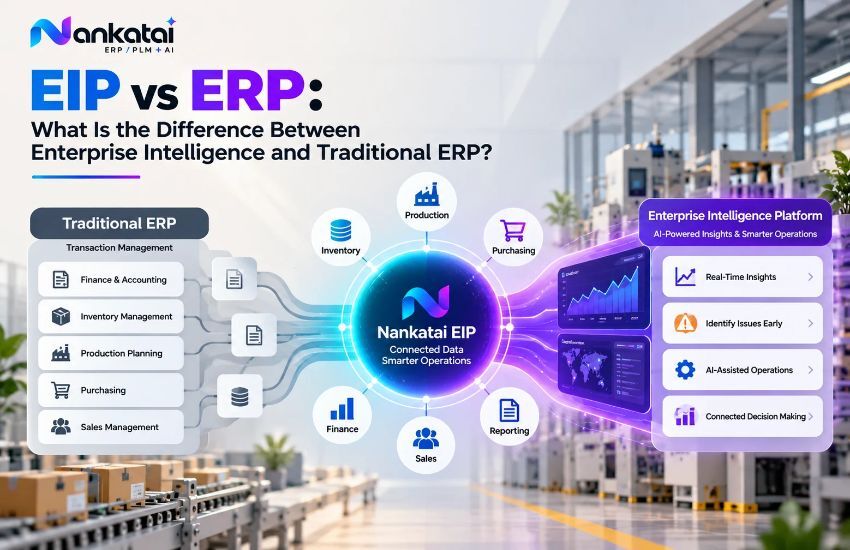
Common ERP modules include:
- Finance and accounting: Handle invoices, payments, expenses, and financial records.
- Inventory management: Monitor stock levels, material movement, and product availability.
- Production planning: Organise manufacturing schedules and resource allocation.
- Purchasing: Coordinate supplier relationships, procurement, and purchase orders.
- Sales management: Maintain customer details, orders, and sales transactions.
For instance, when a manufacturer receives an order, its ERP system can help coordinate stock verification, purchasing, production scheduling, and invoicing.
Traditional ERP systems provide a structured approach to business management. Depending on the product and configuration, modern ERP software can also offer dashboards, analytics, automation, and AI capabilities.
What Is an Enterprise Intelligence Platform?
An Enterprise Intelligence Platform (EIP) brings together business information and AI-driven capabilities to support operational workflows and decision-making.
While transaction management remains the primary focus of many ERP systems, an EIP aims to help businesses interpret data, identify exceptions, and assist with selected tasks using AI agents and automation.
According to its website, Nankatai offers an EIP designed for business operations, with AI agents supporting tasks such as production scheduling, inventory variance analysis, supplier rejection tracking, document processing, and management reporting.
Imagine a factory facing a raw material delivery delay. Employees must examine purchasing records, available stock, production schedules, and customer commitments to assess the situation.
An intelligence-driven platform can bring relevant information together and flag potential issues for further investigation. Employees can then evaluate the findings and decide on appropriate actions.
This illustrates how AI in business can support operational decisions while keeping human judgment central.
For more information about Enterprise Intelligence Platform, check out our blog post, “What Is Nankatai EIP? A Complete Guide!”
EIP vs ERP: Key Differences
The primary difference between ERP and EIP is their focus. ERP software manages transactions and business processes, whereas an EIP emphasises operational intelligence, AI-assisted workflows, and actionable insights.
| Comparison area | Traditional ERP | Enterprise Intelligence Platform |
|---|---|---|
| Main purpose | Manage transactions and essential business processes | Support operational intelligence and AI-assisted tasks |
| Data usage | Stores records and produces reports | Aims to interpret data and highlight relevant issues |
| Automation | Varies by available modules and configuration | Provides AI agents for selected operational activities |
| Decision support | Offers records, reports, and available analytics | Helps surface patterns and information for review |
| Deployment | Depends on the product | Nankatai is designed for on-premise deployment |
| Licensing | May charge per user | Nankatai's website states unlimited-user licensing |
These comparisons describe general differences rather than every available product. Modern ERP systems can also include advanced analytics, AI capabilities, and intelligent automation.
When comparing ERP vs traditional ERP, businesses should therefore focus on actual functionality, integrations, and supported workflows instead of relying only on product categories or labels.
Enterprise Intelligence Platform vs ERP: How Does AI Transform Business Operations?
AI-powered business software helps employees use business information more effectively. Its usefulness, however, depends on data quality, system setup, and specific business needs.
An EIP can support various operational activities through AI-based features:
- Data Analysis: Businesses can review information across departments to investigate stock discrepancies, recognise repeated problems, and assess operational results.
- Data Automation: Configured workflows can handle repetitive activities, process information, and prepare reports, helping reduce manual work.
- AI-assisted operations: AI agents can track selected activities, flag unusual situations, and direct employees' attention to potential issues.
- Sales and customer management: Depending on available features and integrations, AI tools can assist with Sales Automation Tools, Customer Relationship Management (CRM) AI, and Customer data analysis.
For instance, sales teams can study customer information to recognise purchasing trends and identify opportunities for follow-ups. These tools can enhance existing sales activities without necessarily replacing them.
When comparing Enterprise Intelligence Platform vs ERP, companies should check the available AI features and confirm how they integrate with their existing systems.
Can an Enterprise Intelligence Platform Replace ERP?
Businesses often ask, Is EIP an alternative to ERP? The answer depends on their operational requirements and the functions they need.
An EIP may appeal to organizations looking for connected business information and AI-supported operations. However, companies relying on ERP modules for accounting, payroll, compliance, inventory, or financial reporting should verify that these essential functions are supported before replacing their existing system.
In certain situations, an EIP can work alongside ERP software instead of replacing it. Where integration is supported, businesses may retain their established transaction processes while adding intelligence-driven capabilities.
Before deciding, companies should review their functional requirements, data migration needs, integration possibilities, employee training, security measures, and long-term expenses.
Traditional ERP vs Modern Business Platforms: What Should Businesses Evaluate?
When exploring ERP alternatives, businesses should determine how each platform meets their current requirements and supports future growth.
Key considerations include:
- Business needs: Identify the processes that require improvement.
- Integration: Ensure compatibility with existing applications and databases.
- Security: Examine access permissions, backups, and deployment arrangements.
- Scalability: Check whether the platform can handle increasing users and workloads.
- Overall cost: Account for licensing, implementation, maintenance, and training.
Businesses should also determine whether their existing Business management software already offers the required intelligence and automation features. Replacing a working system may be unnecessary when its current capabilities can address the identified challenges.
Conclusion: Making the Right Choice Between EIP and ERP
The EIP vs ERP comparison comes down to how each platform supports business requirements. ERP systems manage transactions and coordinate core processes, whereas an Enterprise Intelligence Platform focuses on connecting business information with AI-assisted workflows and operational insights.
For businesses considering AI-powered business software, Nankatai EIP is worth exploring, particularly when connected information and configured AI capabilities are important priorities.
Evaluating these factors helps organizations decide whether to continue using their ERP, extend its capabilities, or explore another approach to business management.