
Introduction
An entire manufacturing company may be impacted by a production problem, an unforeseen supply shortfall, or a delayed order. The knowledge required to stop these issues frequently already exists, but it is dispersed throughout several departments and systems.
The main purpose of an Enterprise Intelligence Platform (EIP) is to turn business data into meaningful insights. By integrating AI-powered capabilities into industrial processes, Nankatai EIP helps companies link data and enhance daily operations.
When Business Records Fail to Provide the Full Picture
Information is produced by manufacturers all day long. Accounts teams keep an eye on payments, sales teams manage customer orders, buy departments oversee suppliers, and production teams control output. Although each department has its own duties, information from many teams is frequently used to make judgments.
Conventional ERP software assists companies in keeping organized procedures and recording transactions. Teams may need to bring information together, analyse figures, monitor outstanding work, and prioritise issues that demand attention.
Businesses can address these challenges with the help of an enterprise intelligence platform. It goes beyond storing operational information by using AI and connected data to provide context, identify potential issues, and support better decisions.
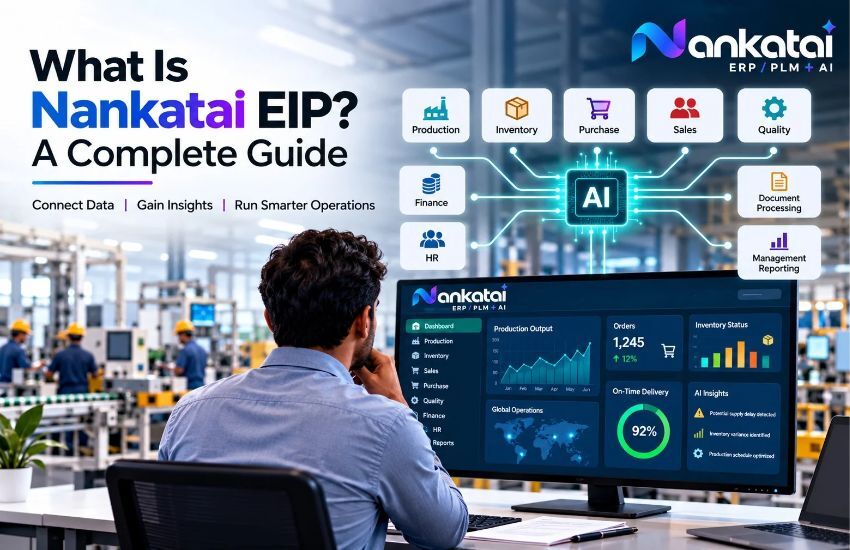
Modelcam Technologies created Nankatai EIP specifically for this manufacturing management methodology. On-premise deployment, flexible workflows, and 66 AI agents spread across 17 departments are highlighted on its official website.
Nankatai EIP provides a method that blends operational management with AI-driven support for manufacturers considering an ERP alternative.
How Nankatai EIP Integrates With Regular Manufacturing Tasks
When business software tackles common operational issues, its worth becomes evident. To serve various business processes, Nankatai EIP combines industrial operations with AI agents.
Consider a factory handling multiple customer orders. A delay in raw material supply can disrupt production schedules, affect delivery timelines, influence purchasing decisions, and require updates to customers. Employees need information from different departments to assess the overall impact.
An intelligence-driven system can bring relevant details together and identify areas that need attention. However, final decisions still rely on business rules, available data, and employee expertise.
Nankatai's website highlights AI agents designed for tasks such as production scheduling, inventory variance analysis, supplier rejection tracking, document processing, and management reporting.
These capabilities aim to support coordination across departments instead of handling every function separately. The results depend on the workflows configured and the quality of available information.
What Sets an Enterprise Intelligence Platform Apart?
An Enterprise Intelligence Platform brings together business data, automation, and AI capabilities to help employees understand information and address operational requirements.
Its purpose can be explained through three main areas:
1. Bringing information together: Connecting relevant systems and workflows can give employees a more complete picture of business operations.
2. Highlighting important issues: AI can identify patterns, flag exceptions, and draw attention to unusual changes that may require investigation.
3. Assisting with routine tasks: Depending on its configuration, business process automation can help with repetitive activities, including information reviews and report preparation.
These functions can reduce the time spent collecting data and allow teams to focus more on operational priorities.
EIP vs ERP: Which Approach Is Right for Your Business?
ERP systems play a vital role in recording transactions, managing business data, and coordinating essential processes. An EIP places greater emphasis on intelligence and AI-assisted operations.
The EIP vs ERP comparison does not mean that one must always replace the other. Modern ERP solutions may also provide analytics, automation, and AI features. The right choice depends on the company's operational requirements.
| Area | Traditional ERP | Nankatai EIP |
|---|---|---|
| Core focus | Managing transactions and business processes | Operational management supported by AI |
| Business information | Maintains records and produces reports | Aims to identify issues and highlight useful insights |
| Automation | Depends on available modules and configuration | Provides AI agents for selected operational tasks |
| Deployment | Depends on the product | Designed for on-premise deployment |
| Licensing | May involve per-user charges | Unlimited-user licensing model |
When comparing EIP vs traditional ERP, manufacturers should assess more than product features. Accounting needs, production planning, data migration, integrations, employee training, security, and long-term expenses all require consideration.
So, can an EIP replace an ERP? It may suit businesses looking for a more AI-oriented approach to operational management. However, companies should verify that the chosen platform supports their essential ERP requirements before switching.
Key Business Benefits of Integrating AI With Operations
When implemented effectively, an intelligence-driven platform can contribute to several business objectives:
Improved cross-department visibility: Connected data can help managers understand operational challenges without depending solely on separate reports.
Reduced repetitive work: AI-supported workflows can automate selected routine activities, giving employees more time to handle exceptions and make decisions.
More informed planning: Data Analysis can help teams examine performance and recognise recurring operational issues.
Flexible workflows: Configurable processes can help businesses adapt software to their manufacturing needs.
Better data control: Nankatai is designed for on-premise deployment. Its website states that business data and AI processing remain within the customer's premises. Companies must also ensure appropriate access controls, backups, and network security.
Support for business expansion: Nankatai's stated unlimited-user licensing model may help manufacturers manage licensing expenses as platform usage grows.
Where Can Nankatai EIP Be Useful?
Nankatai EIP is designed mainly for manufacturing businesses looking to connect operational data and incorporate AI into everyday processes.
It may suit small and medium-sized manufacturers handling production, inventory, purchasing, and accounting. Expanding factories can also assess it when considering software adaptability, licensing expenses, and visibility across operations.
Businesses running older ERP systems can evaluate whether an intelligence-driven platform aligns better with their evolving requirements. Manufacturers that want to retain business data on their premises may also consider its deployment approach.
Customer data analysis, Sales Automation Tools, and Customer Relationship Management (CRM) AI can assist sales teams when the required features, data, and integrations are supported.
What Should Businesses Ask Before Selecting an EIP?
Can an EIP replace all ERP functions?
Not always. Businesses should confirm that essential accounting, inventory, production, compliance, and reporting needs are adequately addressed.
Is Nankatai EIP suitable for small manufacturers?
It may be, depending on business processes, budget, implementation requirements, and operational complexity.
How does AI help automate business processes?
AI can analyse data, flag exceptions, and assist with specific tasks. The level of automation depends on system configuration and business rules.
Does on-premise deployment ensure data security?
No deployment method guarantees complete security. Businesses must also maintain proper permissions, backups, updates, and network protection.
Conclusion: Making Business Data More Valuable
Manufacturers already generate useful information through production records, inventory reports, supplier updates, and customer orders. The real challenge is making this information useful across departments.
Nankatai EIP brings together manufacturing operations management, AI agents, configurable workflows, and on-premise deployment. Businesses comparing conventional ERP software for business with newer AI business software can consider it as one potential option.
The best solution depends on its compatibility with existing processes, integration capabilities, data protection measures, and practical business benefits.
If your business is looking for a more connected approach to manufacturing management, consider evaluating Nankatai EIP against your operational objectives!